

Terms of Reference: Industry workforce development for Malawi’s macadamia sector
- Hybrid
- Lilongwe, Central Region, Malawi
- Project Positions
Job description
Introduction
Malawi Value Chains (MVC), implemented by Adam Smith International, is a component of the FCDO-funded Malawi Trade and Investment Programme (MTIP), a five-year initiative aimed at accelerating exports to break Malawi’s cycle of low growth. The Project focuses on enhancing productivity, quality and export competitiveness of the mango and macadamia value chains, with an emphasis on unlocking commercial opportunities and strengthening the business enabling environment. Through past investment, the macadamia industry has significant potential for increasing employment, driving Malawi’s foreign exchange earnings and increasing Malawi’s GDP.
Background
Through continued interactive sessions with the Malawi Macadamia Association (MMA), which is the umbrella body that represents macadamia-producing estates/farms and processing firms, the industry has identified challenges in recruiting and retaining skilled workforce for key roles in the farms/estates and their processing units, resulting from the growth in the industry, combined with the loss of retirees and others who have passed on, which the industry cannot easily replace. The industry has identified a growing skills gap, unstructured workforce recruitment processes, insufficient career development strategies, and weaknesses in workforce retention strategies.
To date, MVC is implementing an initiative on improving workforce recruitment, skills and retention, through which it is supporting the Lilongwe University of Agriculture and Natural Resources (LUANAR) with increased infusion of macadamia into its teaching programme, enlightening graduates by introducing: (1). macadamia industry lectures, (2). Student field visits to estates/farms and (3) five to six-week student placements at estates/farms. This has included efforts to deliberately engage and encourage female student participation. The students’ placement programme has run for two years and has been found to be very useful to both students and estate owners. However, there are areas that need to be improved, including the programme’s sustainability.
Rapid technological change, shifting employee expectations, and global competition demand a strategic approach to workforce development.
Discussions with the industry have indicated that the few university students who have been attached/ placed at the estates have limited applied knowledge of macadamia, which means that they need to be trained technically on the production and processing systems before they can usefully fulfil their roles on the farm. A second piece of feedback is that students are often unprepared for the realities of applying their knowledge in a farming environment of a commercial nature. LUANAR is the sole producer of agriculture/agri-business graduates, but does not offer modules on macadamia production and processing.
On the other hand, there are gaps in the more senior workforce at the estates and emerging mid-sized farms (MSFs), leaving Human Resources (HR) Departments to depend on promoting junior staff to more senior positions by virtue of long-term service and trust. Overall, there is an insufficient pool of talent interested and positioned to work in the macadamia industry, yet the industry can offer long, remunerative, and rewarding careers and would benefit from sufficient skilled staff.
Many employees, including managers and supervisors, have had career development through in-house and on-the-job training. Upcoming macadamia farmers, particularly the MSFs and smallholder co-operatives, have insufficient knowledge of macadamia farming and orchard management. MSFs and SHF Cooperatives need skilled personnel to manage the farms and/or advise member SHFs.
Retention of staff is also a challenge across the estates as the workforce has a high proportion of those approaching retirement, while at the other end of the spectrum, younger recruits may fail to stay longer at the farms. Even though HR policies exist at most estates, they are not always aligned to the evolving employment context, particularly modern working practices and employees’ expectations.
The MMA’s macadamia industry strategic plan (2023) highlights several areas with regards to current and projected needs in the identification, development and retention of skilled talent through developing a pipeline of technically competent candidates and increasing their working knowledge in macadamia. MMA believes this will contribute to securing the future of the industry through improved productivity and quality performance of the industry. Importantly, reviewing the current placement programme will identify measures suitable for attaining sustainability.
Objectives
MVC with MMA wishes to recruit a consultant who will explore ways in which the macadamia industry can improve its workforce development, especially among producer estates and value addition / processing entities. The focus will be on recruitment, skills development, and workforce retention while also considering the sustainability of the LUANAR Placement Programme.
Specific objectives include to:
Review the current workforce situation and the industry’s future requirements, and determine the dynamics that influence recruitment, bridging of skill gaps, and workforce retention;
Assess the current demand for skilled graduates from the macadamia industry and how Universities and colleges are positioned to supply such graduates, and any prevailing gaps and how they can be addressed.
Identify good/best practices in recruiting, training and retaining that are being implemented by estates, as well as key gaps and the prevalence of these.
Analyse how gender dynamics influence equality and inclusiveness in the workplace and their resultant effects on recruitment, advancement and retention;
Assess existing work-related policies/codes of conduct and determine their appropriateness and key gaps;
Explore with other industries, particularly the tea and coffee associations, on matters relating to their workers in terms of their policies and how they recruit, train and retain.
Recommend best practices that the industry should consider adopting for improved workforce recruitment, development, and retention; Include case studies that have worked well elsewhere that the industry can learn from.
Scope of Work
The Consultant will produce a diagnostic report on workforce development for the macadamia industry and draft workforce development plan for adaptation and/or adoption by the industry. This will include defining the current and future workforce situation, key issues and causes affecting the industry, analysis of Gender Equality & Social Inclusion (GESI) issues, and understanding the workplace policy environment within the industry. The consultant will identify existing gaps within the approaches the industry applies in managing its workforce. The consultant will also assess LUANAR’s current and potential ability to supply skilled graduates to the macadamia industry, and will particularly consider the sustainability of the LUANAR Student Placement Programme
To generate this information and data, and working with the MMA and MVC, the consultant will meet with key management and HR professionals at estates, MSFs and SHF Cooperatives, as well as interviews with the existing workforce, the MMA, MVC, and LUANAR teams. To understand attitudes, expectations and dynamics within the workforce, the consultant will interview members of the workforce as key informants or in group discussions (including female only interviews and groups).
Expected outputs
A report that:
Analyses the workforce and employment situation across recruitment, training and retention, highlighting key factors, challenges, constraints and opportunities specifically relating to the macadamia industry in the context of Malawi;
Sets out good practices that are already being followed by industry players and that are used by similar industries in Malawi and beyond, such as tea and coffee;
Highlights GESI-related issues that can support attracting good quality applicants and retain good employees from both sexes, and practical measures that can attract and retain them;
Sets out an industry-wide action plan with indicative budgets;
Makes recommendations on: (a). Workforce recruitment, training and retention strategies, approaches and practical steps; (b). Industry-wide skills development plans; and (c). appropriate workforce management policies and Code of Conduct;
Assesses the Student Placement Programme, industry lecture programme and student/faculty field days, including how these have performed, what role they have for the industry, and steps to take to make them manageable and sustainable;
Provides relevant case studies that industry players can learn from and adopt.
Present the findings to MVC and MMA on the key findings.
Assignment Deliverables
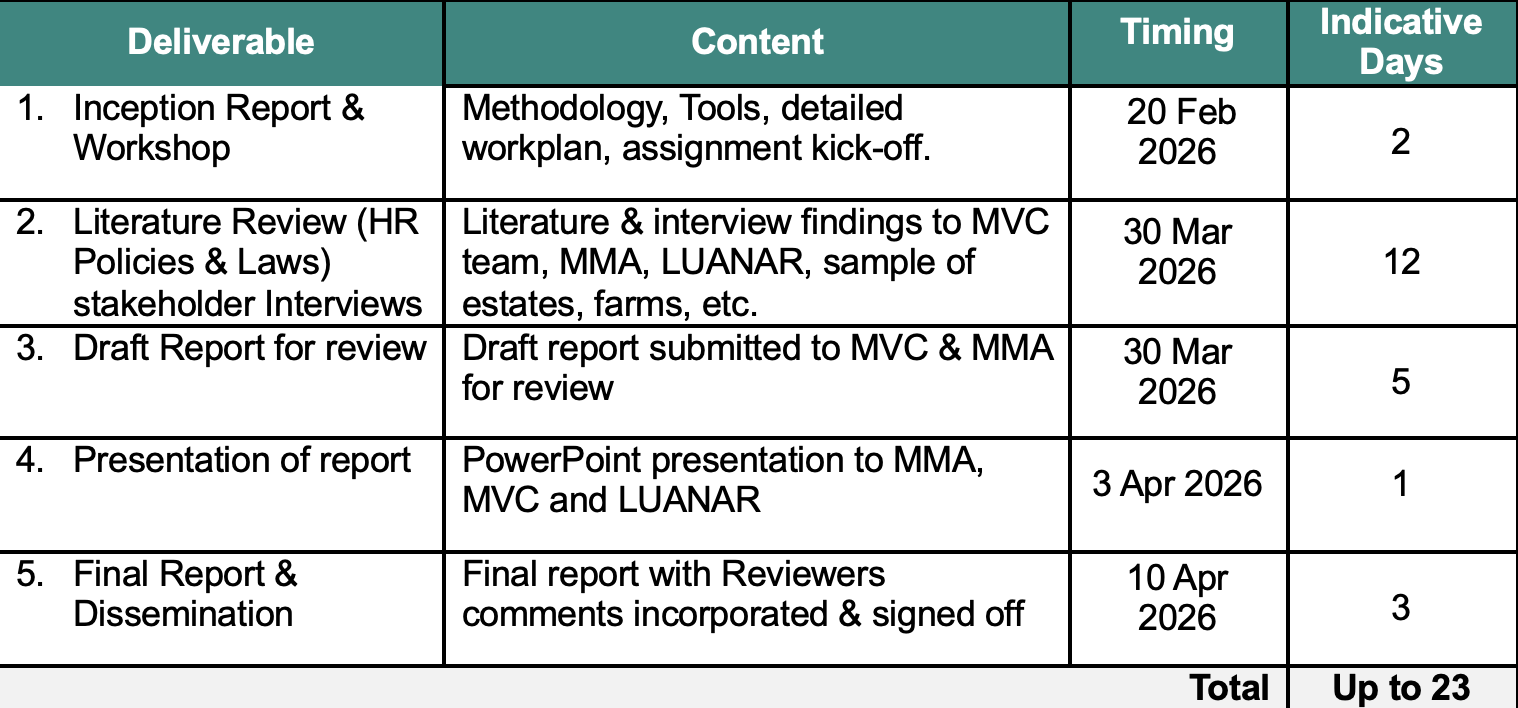
Job requirements
Qualifications
The consultant should possess the following experience and skills:
Master’s degree in Human Resources or other relevant subjects
10 + Years in developing corporate Human Resource, employment policies or related field
Demonstrable knowledge of recruitment, training and retention strategies, ideally in an agricultural/commercial farming environment
Experienced in Malawi’s Labour Laws (experience in International Labour Law would be an added advantage)
Good written, presentational and other communication skills
Experience in issues relating to GESI
How to Apply
Interested and qualified consultants should submit the following:
A technical proposal (maximum 3 pages) detailing their understanding of the assignment, proposed methodology, and work plan
A financial proposal breaking down fee rates and other expenses
Curriculum Vitae (CV) of the proposed consultant(s)
The deadline for submissions 5th January 2026. Technical and financial proposals should be submitted by to: administrator@malawimacadamia.org and copy to info@malawivaluechains.com
or
All done!
Your application has been successfully submitted!