

Terms of Reference - Unlocking Value: Integrating Malawi into Regional and Global Mineral Value Chains
- Hybrid
- Lilongwe, Central Region, Malawi
- Corporate Positions
Job description
Project Background
The Malawi Value Chains (MVC) project, implemented by Adam Smith International (ASI), is one of two components of the Malawi Trade and Investment Programme (MTIP), a five-year FCDO-funded initiative that aims to break Malawi’s cycle of low growth by driving exports. The overall objective for MVC is to implement the value chain component of MTIP, to increase productivity, quality production, and export performance of the macadamia and mango value chains, as well as supporting increased mining investment and, ultimately, exports. Other complementary MTIP components focus on reducing the time and costs of trade and logistics (implemented by TradeMark Africa).
The objective for the Mining Team is to identify, facilitate and support private and public developments in the mining sector that will lead to investment and ultimately increased exports. This includes playing the role of the Development Partner Coordinator (DPC) in the mining sector. The team has developed a work programme in mining that focuses on four key areas, namely: mining investment facilitation (including ancillary infrastructure), public-private dialogue effectiveness, development partner collaboration, and capacity building of government officials and institutions.
This study is expected to inform approaches to investment in mining that promote increased export value and broad-based industrial and social development in the country.
Relevant Context
Global demand for transition and critical minerals is projected to grow by approximately 12% annually through to 2030, according to the International Energy Agency, driven largely by the accelerating shift to clean energy technologies. Minerals such as lithium, cobalt, nickel, graphite and rare earth elements are essential components in the production of electric vehicles, renewable energy solutions and energy storage systems - all of which are experiencing rapid growth in response to global decarbonisation efforts. Meeting this rising demand, however, presents significant challenges, particularly in securing and managing supply chains that are already under considerable strain.
Historically, low- and middle-income countries have served primarily as exporters of raw minerals, with little or no local processing. This pattern has limited their ability to capture the full economic benefits of their natural resources, often resulting in missed opportunities for industrial development, job creation, and technological advancement. Instead, most of the processing and manufacturing has taken place in wealthier nations, reinforcing global inequalities in the value chain. As demand for transition minerals grow, there is a desire by mineral-producing countries and development partners to shift this dynamic by developing domestic refining, manufacturing, and innovation capacity. Doing so not only strengthens global supply chain resilience but also promotes more equitable economic development.
Within this broader context, Southern Africa’s rich mineral reserves represent a significant opportunity for value addition within the region. Today, only 5% of Africa’s transition minerals are processed on the continent, according to the African Energy Council, meaning most of the economic value is captured beyond Africa. Developing local beneficiation and processing capabilities could significantly boost development, employment, and technological capacity across the region.
However, the high capital and technical requirements of establishing such infrastructure, and a supportive investment environment is a barrier for many countries, particularly those with smaller reserves. In response, some governments are pursuing collaborative models, including regional processing hubs and cross-border partnerships, as practical and scalable solutions, notably the DRC and Zambia collaborating to develop value chains for electric batteries (nickel, manganese and cobalt battery precursors). These cooperative approaches enable countries to pool resources, benefit from economies of scale, and attract investment more effectively - meaning wider economic and industrial benefits for Southern Africa as a whole.
Mining sector in Malawi
Malawi is emerging as an active player in the global mining landscape, particularly in the rapidly growing market for critical energy transition minerals. The country is endowed with deposits of transition minerals—such as rare earth elements, rutile (not strictly a transition mineral, but strategic for Malawi), graphite, niobium, and cobalt—fundamental in the production of renewable energy technologies, electric vehicles, and advanced electronics, positioning Malawi as a potential key supplier in the global energy transition.
Beyond the extraction of raw materials, Malawi’s emerging resource wealth presents a broader opportunity for structural economic transformation through value addition. Recognising the sector’s potential, the government has placed mining at the centre of its long-term development agenda. Under the flagship Agriculture, Tourism, and Mining (ATM) Strategy, the Government of Malawi (GoM) aims to diversify the economy by modernising the mining sector, streamlining regulatory frameworks, and increasing processed mineral exports[1]. In tandem, the development of an Energy Transition Minerals (ETM) Roadmap, supported by the World Bank, signals a commitment to ensuring that the sector’s growth delivers broad-based benefits to all Malawians.
With transition and critical minerals becoming increasingly central to global industrial supply chain resilience, Malawi has a timely opportunity to reposition itself within regional and international value chains. By integrating into downstream activities - investing in value addition, infrastructure, skills development, and responsible governance - the country could unlock wider socio-economic benefits, ranging from job creation and domestic supplier development to technological innovation.
Assignment
This value chain analysis seeks to explore the realistic opportunities, constraints, and strategic policy pathways for Malawi moving beyond the relatively unprocessed exports of transition minerals and integrating into downstream activities, advancing practical steps in value addition, linking into regional and global export markets for downstream products, enhancing competitiveness, and promoting inclusive, sustainable growth.
MVC wants to hire a consultant with expert technical knowledge and experience to undertake the proposed study.
The Terms of Reference lays out three phases of work. At this stage we are looking for technical and financial bids for Phases 1 and 2 only. If the activity is successful and funds are available, there is the possibility of extension (Phase 3).
Objectives and Intended Outcomes
The overall objective of this study is to provide key insights into the realistic potential for Malawi’s integration into regional and global transition mineral value chains, focusing on domestic value addition and downstream processing opportunities to increase the economic and wider developmental impacts of the mining sector for Malawi.
A maximum of two mineral value chains will be selected for in-depth analysis. This mapping and analysis will:
Generate actionable insights on the conditions, enablers and entry points for sustainable, value-added transition mineral exports from Malawi focusing on feasibility, regulatory readiness and the role of regional partnerships.
Identify specific realistic/feasible opportunities in value addition and provide the economic rationale for these.
Where possible, identify potential investors and possible partnerships to progress value addition.
Directly inform World Bank programming, which is expected to include some value addition opportunities in graphite.
Guide MVC and other development partner programming by highlighting priority areas for investment or further investigation. Complementary areas that may require additional support include skills and workforce development, as well as follow-up activities such as feasibility studies for targeted value addition investments.
The key audiences for the study are GoM policy makers, private sector mining investors/companies, development partners and financiers.
Scope of Work
Phase 1: Planning, Prioritisation and Value Chain Mapping
Prepare a Study Plan
In the first two weeks of engagement, the consultant team is expected to prepare a detailed study plan, outlining the workplan, methodology (including an approach for selecting which two minerals to include in the value chain analysis) and deliverables. This will guide the full study. Opportunities to produce interim deliverables without additional effort should be considered; for example, the value chain illustrations.
Importantly, the study should have a learning and knowledge management focus to test assumptions and support the generation of actionable insights related to mining-led export growth. The following questions could be considered in methodology design:
Under what conditions do mining investments translate into sustainable export growth for a country like Malawi with its range of constraints?
Which value-addition opportunities are most feasible for Malawi, given technical, financial, policy, operating environment and infrastructural constraints?
What regulatory reforms are needed to enable domestic value addition?
What are the most effective entry points for value addition in Malawi’s context?
What regional partnerships could accelerate mineral value chain development for Malawi?
2. Undertake a rapid assessment of Malawi’s transition mineral potential and prioritise minerals for value chain mapping and assessment
Undertake a rapid scoping assessment of the following minerals in Malawi: graphite[2], rutile, rare earths, niobium, nickel, cobalt, lithium and manganese (the “long-list”) using existing available data and diagnostics.
A. Review Malawi’s existing geological data and exploration results, leveraging resources such as government data, World Bank reports, feasibility studies, and academic sources.
B. Evaluate the status of current exploration and mining activities, including license holders, production capacities, timelines for development and interest in investing in processing.
C. Undertake complexity analyses for these long-list minerals and document, at a high-level, the downstream activities and products that are possible for Malawi.
D. Map any current domestic processing plans (existing and planned facilities) of mining companies, GoM and other.
E. Propose a maximum of two minerals to undergo value chain mapping and assessment using the agreed prioritisation approach.
3. Map the full mineral value chain for a maximum of two priority minerals
Conduct a detailed mapping of Malawi’s high potential mineral value chains (maximum two), from the point of extraction through to end use.
For each prioritised mineral:
identify and document each stage of the mineral value chain, from extraction to processing, refining, transport, marketing, export, manufacturing and end consumer sale.
profile the key actors and institutions involved in the value chain and map their geographical distribution, including likely investors/mining companies, off-takers/ processors, relevant regulators, national and regional logistics providers, mining financial institutions.
identify high potential linkages between upstream and downstream activities, including the extent of vertical integration or fragmentation within the processing state of the chain relevant to Malawi.
assess the interest of the private sector in investing in processing and/or forming public-private partnerships (PPPs).
assess the flow of materials and information across the chain, noting where coordination is strong or weak, and identifying bottlenecks or inefficiencies.
illustrate the chain visually, using diagrams or flowcharts to provide a clear representation of how minerals currently move from raw material through intermediate to final mineral products.
Phase 2: Assessment of Value Opportunity and Value Loss, Market Analysis
Analyse value opportunity and value loss across the value chain, pinpointing areas where value is lost through export of the basic materials and where more could be gained through midstream or downstream processing activities.
Quantify the economic value generated at each stage of the mineral value chain, using indicators such as output value, employment, tax revenues, local procurement, and linkages to other sectors, using existing data sources.
Assess the value that could be retained in Malawi, from further processing/refining and manufacturing.
Identify points of "value leakage", where raw minerals are exported before significant domestic could realistically be value added (e.g., beneficiation, processing refining).
Compare potential value scenarios, showing the difference between exporting raw minerals versus developing midstream and downstream capabilities and assess the steps that Malawi can realistically take midstream and even downstream in the respective minerals given current capabilities. Consider the scenario of Malawi stand-alone versus Malawi as part of a cooperative regional approach.
Analyse fiscal implications, specifically the duties, royalties, and taxes that could be gained from further processing in country.
Review current policies and investment incentives to determine whether they support or discourage domestic value addition.
Explore the causes of limited domestic processing and manufacturing capacity, including infrastructure gaps, energy, transport and electricity access and interconnectivity, technical and technological limitations, regulatory barriers, human capital and skills shortages, governance issues and investment constraints.
Benchmark against other mineral-producing countries that have successfully increased domestic value retention and extract relevant lessons for Malawi.
Develop evidence-based recommendations on how Malawi can reduce value leakage and strengthen its share of high-value activities.
2. Examine global and regional market dynamics, including demand trends, pricing structures, and trade relationships.
Conduct an analysis of the global and regional market environment for prioritised transition minerals to understand the external factors influencing competitiveness, value addition potential, and trade positioning.
Track global demand trends for prioritised minerals
Analyse global pricing structures and how prices are determined across different stages of the value chain — including spot markets, long-term contracts, and influence of dominant market players.
Map Malawi’s current trade relationships for its mineral exports, including trading partners, volumes, destinations, and value realised at point of export.
Study regional and global trade flows, including intra-African mineral trade and Malawi’s position in Southern African mineral corridors, to identify both opportunities and competition.
Examine trade agreements and regional frameworks, such as the African Continental Free Trade Area (AfCFTA), Southern African Development Community (SADC), Common Market for Eastern and Southern Africa (COMESA) and bilateral trade deals, for their potential to enhance market access and integration.
Explore trends in mineral traceability, ethical sourcing, and environmental standards, which are increasingly demanded by buyers and may shape export potential.
Identify some early value addition opportunities for further investigation in Phase 3.
Phase 3 is included for information purposes only. Bids should only respond to Phase 1 and Phase 2.
Phase 3: Identifying Viable Value Addition Interventions
Assess practical measures for value addition and opportunities for upgrading, quantify the potential economic benefits of domestic value addition, and assess technical and economic feasibility of interventions.
Identify realistic, actionable opportunities for Malawi to move down the mineral value chain and estimate the potential economic and fiscal returns from doing so. This assessment should focus on both near-term and longer-term opportunities and be grounded in Malawi’s resource base, capabilities, and market realities.
Identify specific value addition opportunities and assess their technical and economic feasibility.
Assess the readiness and suitability of existing infrastructure, workforce, and policy environment to support the pathways of processing value addition and recommend improvements to ensure effective movement along the value chain.
Determine the investment requirements — technical, financial, technological, and human — for implementing different value-adding activities at scale.
Quantify the potential economic impact of specific value addition opportunities, using economic modelling (including economic contribution, export earnings, job creation, government revenues and local supplier development).
Assess the environmental and social implications of different value addition strategies to ensure sustainable development and community benefit.
Prioritise specific value addition opportunities based on impact potential and implementation readiness, distinguishing between “investment ready” and longer-term strategic projects.
Draw from regional and global examples of successful mineral beneficiation strategies to identify best practices and avoid common pitfalls.
2. Engage stakeholders to validate findings and build consensus on priority value chain opportunities and strategies
Design and implement a structured stakeholder engagement process to ensure that the findings of the mineral value chain analysis are accurate, grounded in local realities, and aligned with the interests and capacities of key actors. This process should also build ownership and consensus around actionable strategies to enhance value addition and competitiveness in Malawi’s mineral sector.
Conduct multi-stakeholder consultations, including targeted interviews to discuss specific interventions
Facilitate consensus-building sessions to agree the prioritisation of the most viable and impactful opportunities for upgrading, including a senior level meeting for relevant policymakers.
Encourage dialogue between upstream and downstream actors, including mining companies and potential local processors, to explore collaboration opportunities.
Produce a policy brief capturing key recommendations
Deliverables
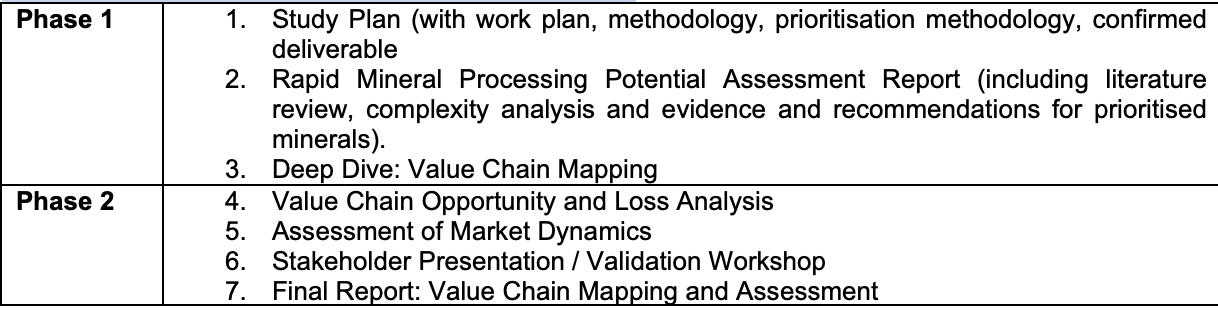
The Contractor will provide the following deliverables:
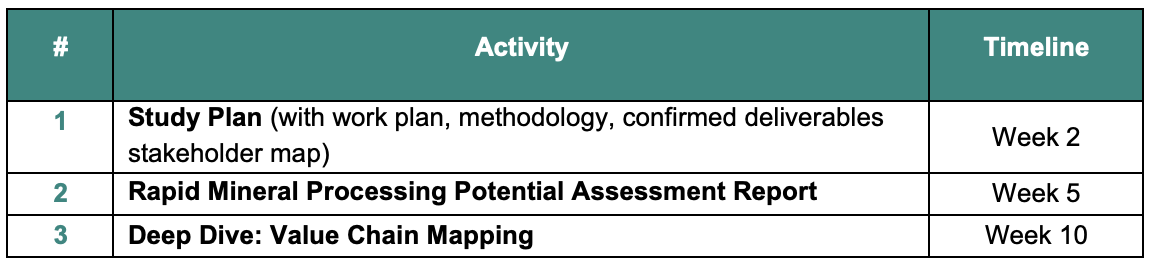
Timing and Duration – Phase 1
The first phase of this assignment should commence as soon as possible.
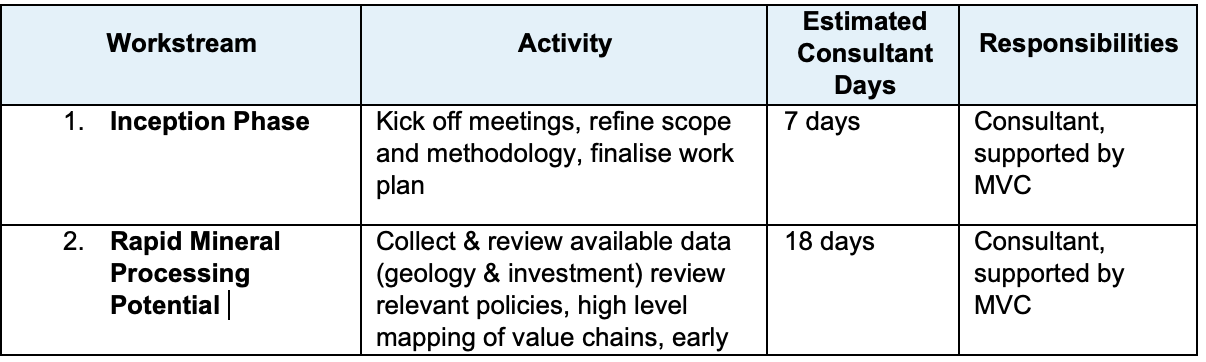
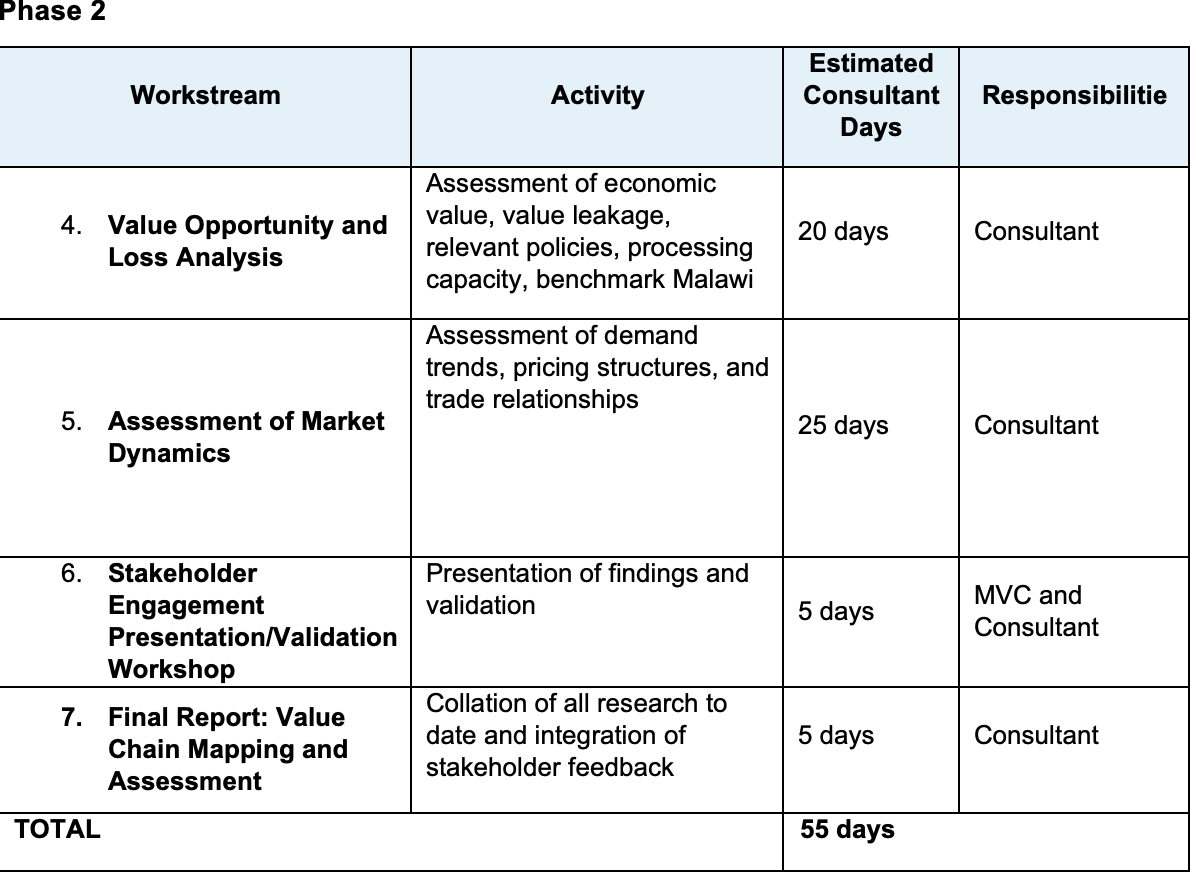
Estimated Level of Effort and Responsibilities
Phase 1

Required Expertise
The study team should consist of multidisciplinary expertise, including
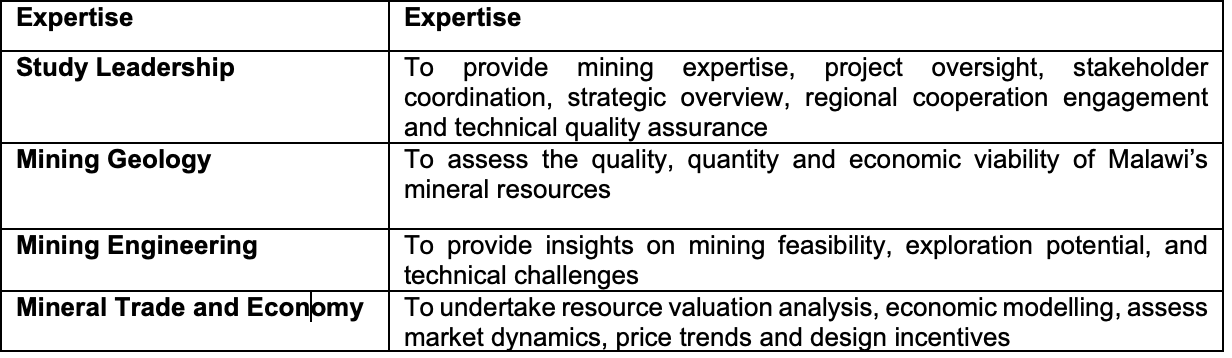
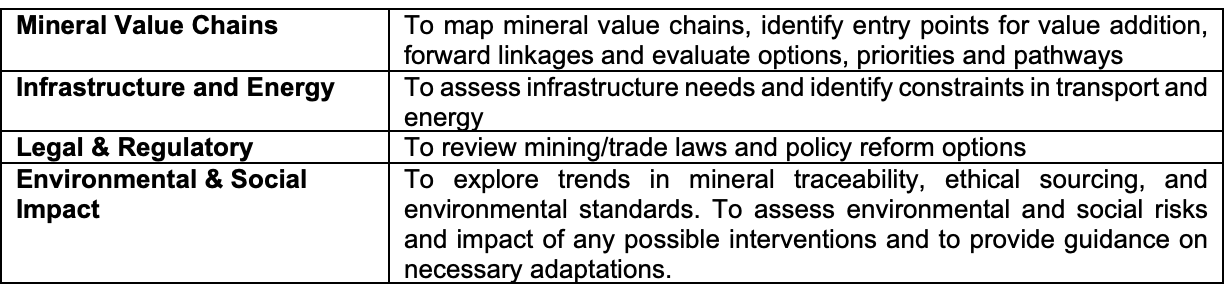
or
All done!
Your application has been successfully submitted!